Purchase hesitation is the moment a shopper intends to buy but pauses due to perceived risk, unresolved doubt, or uncertainty about the decision. It is not a checkout design flaw. It is friction inside the buyer’s mind, triggered by unanswered questions about product fit, cost transparency, delivery timing, return policies, or brand trust. The Baymard Institute and behavioral researchers have documented how this internal conflict surfaces as cart abandonment, checkout pauses, and repeated field toggling — but the part most teams miss is that this hesitation follows a measurable timeline, and only a narrow slice of that timeline is recoverable.
What is purchase hesitation in ecommerce, and why does it happen?
Purchase hesitation, also called decision confidence decline, is the gap between a shopper’s desire to buy and their willingness to commit. Hesitation is not just friction in the interface. It is a decline in the buyer’s confidence in their own judgment. The shopper asks: “Am I making the right call?” That question, left unanswered, kills the sale.
The psychological roots fall into three risk categories: identity risk (will this product reflect well on me?), effort risk (is this worth my time and energy?), and future risk (what happens if something goes wrong?). Each category maps to specific doubts shoppers carry from browsing through checkout. A buyer evaluating a $300 jacket faces all three simultaneously.
These doubts evolve as the purchase journey progresses. Early in browsing, hesitation is abstract. Near checkout, it becomes concrete. The closer to checkout, the stronger the tradeoff between desire and risk becomes, turning abstract interest into a real financial and trust decision. That shift is where most conversions are lost.
- Product fit doubt: “Will this actually work for my situation?”
- Price transparency doubt: “Are there hidden fees I haven’t seen yet?”
- Delivery doubt: “Will this arrive when I need it?”
- Return policy doubt: “Can I get my money back if this is wrong?”
- Brand trust doubt: “Is this company legitimate and secure?”
How purchase hesitation shows up in ecommerce user behavior
Hesitation does not announce itself. It shows up in micro-behaviors that most analytics platforms miss entirely — pauses before payment entry, repeated field toggling, scroll reversals, and cursor hover patterns. These behaviors are the behavioral signature of a buyer who wants to buy but cannot commit.
The four most common behavioral signals of hesitation in checkout flows are:
- Decision pauses before payment fields: The buyer stops typing and stares at the screen. This pause often lasts 10 to 30 seconds and signals an unresolved trust or cost question.
- Repeated scrolling back through the order summary: The buyer re-reads item details, shipping costs, or return terms. They are looking for reassurance they did not find the first time.
- Field toggling between payment and shipping sections: The buyer moves back and forth between form fields without completing either. This signals confusion or doubt about the total cost.
- Post-click anxiety at the confirmation step: Even after clicking “Place Order,” buyers experience a perpetual maybe state, where missing answers about tracking, returns, and guarantees sustain doubt after the transaction.
Session recordings from tools like Hotjar and FullStory reveal these patterns clearly. The data below shows where hesitation spikes most frequently in a standard checkout flow:
| Checkout stage | Primary hesitation trigger | Behavioral signal |
|---|---|---|
| Cart review | Hidden or unexpected costs | Scroll back, cart edit |
| Account creation | Forced registration wall | Drop-off, rage clicks |
| Payment entry | Payment security doubt | Pause, field toggle |
| Order confirmation | Missing return or tracking info | Post-click anxiety |
Over-optimizing visible checkout elements can miss the hesitation triggers that arise from these micro-behaviors entirely. Session replays and cursor tracking reveal invisible barriers that A/B tests on button colors will never surface — and, just as importantly, they reveal when in a session each barrier appears. That timing is the part this article is really about.
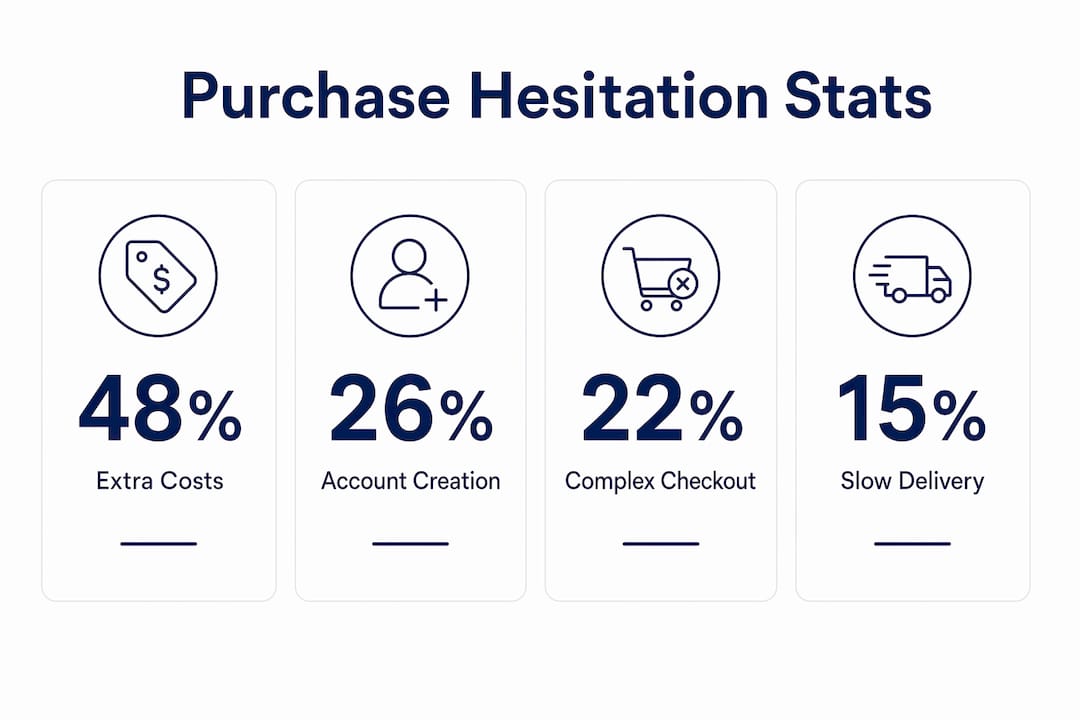
Top factors contributing to cart abandonment and purchase hesitation
External and operational factors account for the majority of measurable hesitation. The largest reasons for checkout abandonment are extra costs too high at 48%, forced account creation at 26%, and complex checkout processes at 22%. Inability to see total cost upfront drives 21% of abandonment, slow delivery accounts for 19%, and lack of trust in payment security causes 18% of shoppers to leave.
Each of these is a controllable variable. That is the critical insight. These are not random buyer behaviors. They are predictable responses to specific operational failures that e-commerce teams can fix.
| Hesitation trigger | Abandonment rate | Solution |
|---|---|---|
| Extra or hidden costs | 48% | Show total cost early, including tax and shipping |
| Forced account creation | 26% | Offer guest checkout as the default path |
| Complex checkout process | 22% | Reduce form fields; use autofill and address lookup |
| No upfront cost visibility | 21% | Display order summary with all fees before payment step |
| Slow or unclear delivery | 19% | Show delivery date estimates on product and cart pages |
| Payment security concerns | 18% | Display SSL badges, accepted payment logos, and guarantees |
Browser extensions and unauthorized ads add another layer of hesitation that most teams overlook entirely. Coupon-hunting extensions interrupt the checkout flow at the exact moment a buyer is closest to committing. This creates doubt about whether the buyer is getting the best price, which is a direct hesitation trigger. BrandLock’s research on coupon extension behavior shows how these interruptions erode buyer confidence at the worst possible moment.
The hesitant shopper window: why most offers fire at the wrong time
The reason discounts and exit-intent popups underperform is not that offers don’t work. It’s that most offers reach the wrong shopper at the wrong moment. Purchase intent is not flat across a session — it follows a measurable curve, and intervention only changes the outcome inside a narrow band of that curve.
BrandLock models this curve in real time from live behavioral signals, then sorts every active session into four intent zones. In a representative checkout flow, those zones map roughly like this:

Each zone calls for a different response:

- Avg Intent Threshold: Roughly 50% of all high-intent actions (add-to-cart or moving toward checkout) have already happened. These shoppers showed strong intent early and don’t need an offer — discounting them simply hands away revenue you were going to capture anyway.
- Peak Interest Threshold: About 80% of high-intent actions are now complete. Anyone converting on momentum already has. BrandLock excludes these high-intent shoppers from engagement, because intervention here is unnecessary.
- Nudge Window: The band that matters. These shoppers are still engaged but have taken no high-intent action — they’re hesitating. Left alone, they’re the most likely to drop. A timely, intelligent offer here is the one intervention that actually changes the outcome.
- Exit Zone: Session abandonment is now highly likely. This is exactly where most tools fire exit-intent popups — and exactly why those popups underperform. Recovery probability is low.
Read across that timeline and two uncomfortable truths fall out:
- You’re discounting people who were always going to buy. By the Peak Interest Threshold, ~80% of high-intent actions have already happened. Blanket offers reach those shoppers too — and quietly give away revenue you’d have earned at full price.
- Your exit popups fire after the buyer has mentally left. By the time exit intent triggers, the shopper is in the Exit Zone, where recovery is low. A last-second discount mostly trains shoppers to wait for one next time.
The genuinely recoverable shopper sits in a narrow window — engaged, unconverted, and about to leave. That window, not the popup and not the blanket coupon, is where conversion is won or lost.
Effective strategies to reduce purchase hesitation and increase conversions
Reducing purchase hesitation requires addressing the buyer’s internal doubt, not just the checkout interface. Discounts rarely fix hesitation because the core problem is psychological friction tied to identity, effort, and future risks. Throwing a 10% coupon at a buyer who doubts your return policy does not resolve the doubt. It adds a new variable to an already uncertain decision.
The strategies that work target specific doubt categories with specific reassurances:
- Implement guest checkout as the default. Guest checkout reduces forced account creation abandonment from 26% to approximately 8%. Make account creation optional and post-purchase, not a gate.
- Deploy live human support at checkout. Real-time interaction resolves subtle doubts that static FAQ pages and chatbots cannot. An agent who can answer “will this fit my 2019 model?” closes sales automated systems lose.
- Time your nudge to the hesitation window, not the exit. Cursor movements, scroll reversals, and field hover times tell you when a shopper is hesitating. The highest-converting nudge isn’t the biggest discount — it’s the one that lands in the Nudge Window, before the shopper crosses into the Exit Zone.
- Make policies visible at decision points. Return policies, shipping timelines, and money-back guarantees belong next to the “Place Order” button, not in the footer. Placement matters as much as content.
- Segment by intent, not just by stage. A shopper who has already added to cart needs no offer at all — chasing them erodes revenue. A still-browsing, still-engaged shopper at minute six needs a reason to commit now. Serving the same intervention to both is how budgets get burned and conversions get missed.
Why hesitation is a decision support problem, not a UX problem
Most e-commerce teams treat cart abandonment as a funnel metric and respond with retargeting ads and discount codes. That approach treats the symptom, not the cause. Across conversion data from dozens of checkout flows, the pattern is consistent: the sites with the lowest hesitation rates are not the ones with the cleanest UI. They are the ones that answer the buyer’s specific doubt at the exact moment it arises.
The uncomfortable truth is that most checkout optimization targets what teams can see and measure easily: button placement, page load speed, form field count. The hesitation that actually kills conversions is invisible in standard analytics. It lives in a three-second pause before the payment field, a scroll back to check a return policy that isn’t there, a moment of doubt no retargeting email can recover.
The shift worth making is from “how do we reduce friction in the interface?” to “which shopper is hesitating, and is this the moment intervention can still work?” That reframe changes what you build, what you measure, and where you invest. Behavioral trigger systems, intent-zone segmentation, and reassurance architecture near the “Place Order” button all follow from that question. Generic checkout redesigns do not.
— BrandLock Analytics
How BrandLock turns hesitation into recovered revenue
BrandLock’s hesitant-shopper offering is built on a single principle: intervene only when intervention works. Instead of blasting every visitor with popups or blanket discounts, BrandLock reads each live session’s behavioral signals in real time and isolates the shoppers genuinely hesitating inside the Nudge Window — engaged, unconverted, and about to leave.
For those shoppers, and only those shoppers, BrandLock deploys intelligent offers calibrated to the doubt holding them back. High-intent shoppers who were always going to buy are left alone, so you don’t give away revenue you’d have earned anyway. Shoppers already in the Exit Zone aren’t chased with offers that won’t land.
The same engine also blocks the hidden interruptions that manufacture hesitation in the first place: coupon-hunting browser extensions that launch mid-checkout, unauthorized ads that pull buyers off-site, and external distractions that shatter confidence right before the final click.
Enterprises using BrandLock report revenue lifts of 2 to 3%, with some cases showing up to 149x ROI. To see where your own abandonment is leaking, start with the unseen causes of cart abandonment and map them against your intent timeline.
Key takeaways
| Point | Details |
|---|---|
| Hesitation is psychological, not technical | Buyers pause due to unresolved doubt about fit, cost, trust, and risk, not poor design alone. |
| Hidden costs are the top trigger | Extra or unexpected costs drive 48% of checkout abandonment and must be shown early. |
| Guest checkout is a high-impact fix | Switching to guest checkout as default cuts account-creation abandonment from 26% to 8%. |
| Timing beats tactics | Offers only change the outcome inside a narrow Nudge Window — the short band just before a hesitating shopper exits. |
| Don’t discount the already-convinced | By the Peak Interest Threshold, ~80% of high-intent actions have happened. Offering them a discount gives away revenue you’d have captured anyway. |
| Exit popups fire too late | Once a shopper reaches the Exit Zone, recovery probability is low and exit-intent pops are largely ineffective. |
FAQ
What is purchase hesitation in ecommerce?
Purchase hesitation is the moment a shopper intends to buy but pauses due to perceived risk, unresolved doubt, or uncertainty about product fit, cost, delivery, or brand trust. It is a decline in decision confidence, not a checkout design problem.
What are the most common causes of purchase hesitation?
The top causes are unexpected extra costs (48%), forced account creation (26%), complex checkout processes (22%), and lack of payment security trust (18%). Each represents a specific, fixable operational gap.
How does purchase hesitation differ from cart abandonment?
Cart abandonment is the measurable outcome. Purchase hesitation is the internal psychological state that causes it. A buyer can hesitate and still complete a purchase if the right reassurance appears at the right moment.
When is the best moment to show a hesitant shopper an offer?
Inside the Nudge Window — the short band where a shopper is still engaged but hasn’t taken any high-intent action (no add-to-cart, no checkout movement). Before that, most converting shoppers have already shown intent and don’t need an offer; after that, they’ve entered the Exit Zone, where recovery is low.
Why don’t exit-intent popups recover hesitant shoppers?
Exit-intent popups fire when a shopper is already leaving — squarely inside the Exit Zone, where session-abandonment likelihood is high and recovery probability is low. The shopper has mentally checked out. Intervening earlier — in the Nudge Window, while the shopper is still engaged — is what actually changes the outcome.
Won’t offering discounts to hesitant shoppers cost me revenue?
Only if you offer indiscriminately. The risk comes from discounting shoppers who were always going to buy — the high-intent group that converts early. BrandLock excludes those shoppers entirely and reserves intelligent offers for genuinely hesitating shoppers in the Nudge Window, so you protect the revenue you’d have earned at full price while recovering sales you’d otherwise lose.
Does offering discounts reduce purchase hesitation?
Discounts rarely fix hesitation on their own, because the core problem is psychological friction tied to trust, identity, and risk, not price alone. Risk-reduction messaging and visible guarantees outperform incentive-only approaches for buyers already intent on purchasing.


