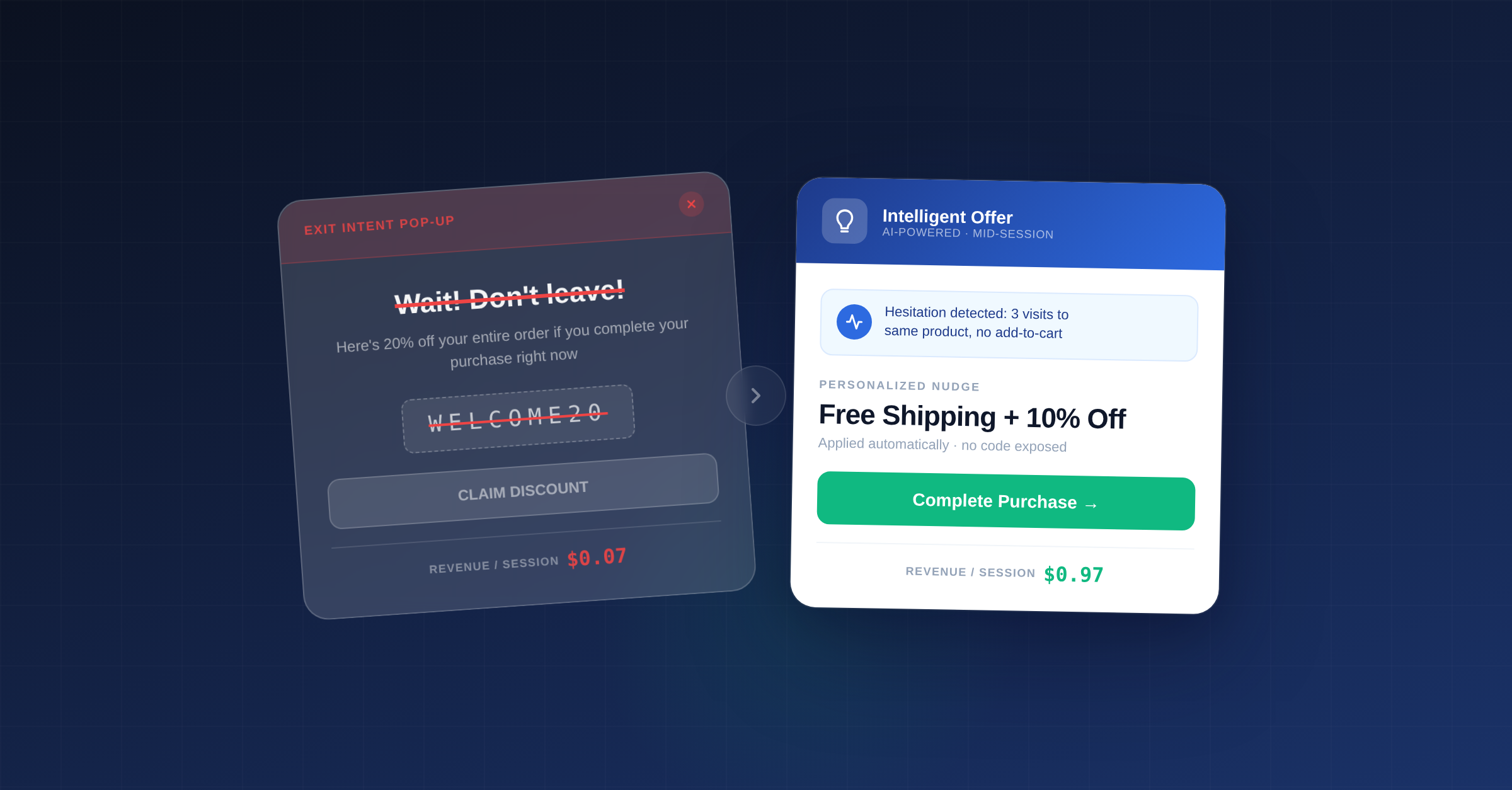
They fire for every visitor. They train shoppers to expect discounts. They damage your brand while pretending to save it. Here’s what smart brands are doing instead.
70%of shopping carts are abandoned before checkout, every | 41%of consumers say | 56%of sessions that were going to convert either way get hit with an overactive abandoned cart Brandlock Labs | 96%decrease in pops shown by using AI powered abandoned sessions rescue saving you from pop up fatigue Brandlock Labs |
There’s a moment every online shopper knows well. You’ve been browsing. Maybe you added something to your cart, maybe you didn’t. You move your cursor toward the browser tab and suddenly, a box slams into your screen. “Wait! Get 15% off before you go!”
Sometimes you take it. More often, you close it, mildly annoyed. If you’ve seen it on the same site three times this month, you’ve probably started to expect it, maybe even game it. That’s the exit intent pop-up in its natural habitat: a blunt, indiscriminate tool that treats every single visitor identically, regardless of who they are, what they want, or whether they were ever going to buy.
For years, e-commerce brands have deployed exit intent as a kind of digital panic button. And in a vacuum, it can nudge a conversion. But the real cost to brand equity, to customer trust, to full-price purchase behaviour is something the conversion rate reports don’t show you.
The OLD Way vs. The NEW Way
For decades, e-commerce has relied on generic offers to drive conversions: email blasts, banner ads, welcome discounts, and exit intent pop-ups. These blanket tactics share a common flaw, they treat every visitor identically, firing indiscriminately regardless of intent, engagement, or likelihood to purchase. They are the OLD way.
The NEW way is intelligent offers. AI-powered, behaviourally triggered interventions that read shopper intent in real time, activate only at genuine friction points, and deliver calibrated nudges throughout the session, not just at the moment of exit. Intelligent offers don’t wait for a departing cursor. They work all day long, across every session, identifying the right moment and the right message for each individual shopper.
The data now proves what the logic has always suggested: timing and intent-based targeting are materially more impactful than higher discount values alone. And the performance gap isn’t small it’s orders of magnitude.
How exit intent pop-ups actually work
Exit intent technology was designed to solve a real problem. According to the Baymard Institute, the average cart abandonment rate across global e-commerce sits at a stubborn 70.19% meaning seven out of every ten shoppers who add something to their cart walk away without buying. That’s a staggering number, and it’s barely moved in a decade.
Exit intent tries to intercept that moment of departure. A JavaScript snippet monitors cursor movements on desktop the moment your mouse drifts toward the browser chrome, the URL bar, or the tab close button, a pop-up fires. On mobile, where there’s no cursor to track, the triggers are less precise: switching tabs, tapping the back button, a burst of upward scrolling. The whole system is built on a single detection signal: I think this person is about to leave.
THE CORE PROBLEMExit intent has no idea why someone is leaving. The window-shopper. The loyal customer switching between multiple tabs of your site. The person who is in the middle of your buying cycle and will most likely buy next week at full price. They all get the same pop-up. |
Most popup tools market this as a feature: the ability to show an offer to every visitor, on every page, the moment they try to leave. For brands that have spent years building a premium customer experience, that indiscriminate reach should be a warning sign, not a selling point.
Six ways exit intent pop-ups hurt your brand
They fire for every visitor, including people who were never going to leave
Baymard’s research found that 43% of cart abandoners were simply browsing and not ready to buy, not price-sensitive, not distracted. They were exploring. Exit intent fires for these people too. You’ve just interrupted a window shopper with an urgent discount offer and told every future visitor that discounts are always one mouse-movement away.
They train your best customers to expect discounts
Research across machine learning-based discounting confirms it: traditional blanket discount strategies including exit intent teach shoppers that patience is profitable. They add to cart. They move the cursor. The discount appears. They learn the game. Over time, you’ve built an audience that won’t buy at full price. This discount conditioning is especially damaging for premium and DTC brands where brand equity is the product.
Pop-up fatigue is real and it’s accelerating
An Adobe survey of over 1,000 consumers found that ads, alerts, and cookie banners are the single most frustrating digital experience, cited by 41% of respondents, topping every other annoyance on the list.
THE COMPOUNDING EFFECTThe difference in exposure is stark: exit intent pop-ups fire for 100% of visitors, on every session, with no memory of who’s already seen them. BrandLock’s AI shows multiple nudges to fewer than 2% of the shoppers it intervenes with because most shoppers only need one well-timed signal, not a barrage. |
They perform worse than engagement-based alternatives
The pattern is consistent and intuitive: “exit-intent popups often function as a last resort message that appears when visitors are already leaving. Many of those visitors have already disengaged, are distracted, or in a hurry so users who were truly going to abandon rarely convert, even if the offer is strong. What you get is users in the middle of the buying cycle getting their AOV watered down”
By contrast, behaviour-based triggers that catch shoppers during active browsing when interest is highest and the message feels relevant to what they’re currently doing consistently outperform exit intent across every major industry benchmark. The gap is not marginal. A shopper who has demonstrated genuine hesitation mid-session is far more valuable to engage than one whose cursor happened to drift toward the address bar. Exit intent cannot tell the difference.
THE DATA: INTELLIGENT OFFERS VS. BLANKET OFFERSOver a comparable 31-day period, a leading e-commerce brand ran two offer types side by side: a behaviourally triggered intelligent offer (a smaller discount shown only to shoppers whose conversion likelihood had declined by 90% vs. their peer microsegment) and a broad 20% welcome offer displayed to all new visitors within the first 5–10 seconds of session start, regardless of intent. |
The results were unambiguous:
Metric | Intelligent Offer | Blanket Welcome Offer |
Revenue per Session | ~13x higher | Baseline |
Engagement Rate | 2.11% | 0.01% |
Engagement Improvement | 210x | — |
Conversion Rate | 0.29% | 0.01% |
Conversion Efficiency | ~29x | — |
Sessions Required | ~213K sessions | ~3.5M sessions (16x more) |
Data source: Brandlock Labs
Despite offering a smaller discount (10% vs. 20%), the intelligent offer delivered substantially stronger engagement, conversion, and revenue efficiency because it activated during high-friction, high-intent moments rather than blanketing every new visitor on arrival.
Meanwhile, the blanket welcome offer, shown broadly to all new users early in the session, drove minimal interaction, produced negligible conversion efficiency, and risked discounting shoppers who would have converted organically at full price. The welcome offer required approximately 16x more traffic exposure to generate only slightly higher total revenue. That is not a strategy. That is a waste.
They leak your discount codes to browser extensions
This one hits closest to home. When you deploy an exit intent pop-up with a discount code “Use SAVE15 before you go” that code doesn’t stay between you and the customer. Browser extensions like Honey, Coupert, and Capital One Shopping actively harvest publicly visible discount codes from exit intent flows, store them in their databases, and serve them to future shoppers on your store including those who were heading to checkout at full price.
Your exit intent pop-up, designed to recover abandoning visitors, has just become an automatic discount engine for every future customer, courtesy of affiliate coupon extensions. The tool meant to protect revenue quietly becomes one of the biggest sources of coupon leakage.
On mobile, where most shopping happens exit intent barely works at all
Mobile devices account for the majority of e-commerce browsing, yet there is no reliable way to track exit intent on mobile. Without a mouse cursor, tools resort to blunt proxies tapping the back button, switching tabs, rapid scrolling up. These signals frequently misfire for users who are simply navigating naturally. The result is a higher rate of frustrated, accidental triggers on the device where your brand experience matters most.
The real problem: Exit intent is reactive. Revenue protection requires being preemptive.
Exit intent was built on a reactive philosophy: wait for the customer to try to leave, then stop them. It treats a departing visitor as a problem to solve at the last second. But by the time a shopper’s cursor is heading for the close button, you’ve already lost the conversation.
The most effective shopper interventions don’t wait for exit signals. They read behavioral intent as it unfolds time on a product page, number of visits to the same item, price comparison behavior, cart composition, scroll depth and deliver the right message at the right moment, before hesitation turns into departure.
This is the distinction between a blunt instrument and an intelligent one. And the data is definitive: AI-powered personalization that triggers offers only when shopper behavior signals genuine purchase risk doesn’t just convert better, it preserves brand equity, protects full-price purchase rates, and builds the kind of trust that generates lifetime value.
THE BEHAVIORAL EVIDENCEBrands using AI-driven intent-based offers triggered only on genuine hesitation signals consistently maintained conversion rates while protecting full-price purchase rates. The technology identifies which shoppers respond to incentives and which will buy regardless of a distinction that exit intent is constitutionally unable to make. |
Exit Intent vs. BrandLock’s AI Preemptive Nudges
Exit Intent Pop-Ups | BrandLock AI Preemptive Nudges |
|---|---|
| ✕ Fires for every visitor, regardless of intent or likelihood to purchase | ✓ Shown only to shoppers whose behavioral signals indicate genuine purchase risk |
| ✕ Triggered by one blunt signal: cursor moving toward browser chrome | ✓ Reads multiple signals: session depth, product revisits, price comparison patterns, cart hesitation |
| ✕ Cannot distinguish loyal customers from first-time bouncers | ✓ Segments loyal customers from casual browsers different interventions for each |
| ✕ Delivers the same discount offer to everyone on the page | ✓ Delivers calibrated, contextual nudges not blanket discount codes |
| ✕ Fires after the shopper has already decided to leave | ✓ Intervenes mid-session, while the shopper is still engaged |
| ✕ Trains price-sensitive behaviour, eroding full-price purchases over time | ✓ Preserves full-price purchase rates by offering discounts only when necessary |
| ✕ Leaks discount codes into the browser extension coupon ecosystem | ✓ No coupon codes exposed to browser extension harvesting |
| ✕ Unreliable on mobile because no cursor movement to track | ✓ Behaviour-based signals work seamlessly across desktop and mobile |
| ✕ Creates pop-up fatigue, negative brand associations, and trust damage | ✓ Feels helpful and brand-consistent, not intrusive |
| ✕ Consistently underperforms engagement-based triggers, fires at the worst possible moment | ✓ Fires mid-session, when engagement is highest and conversion is most likely |
| ✕ Fires on every session for 100% of visitors, with no session memory | ✓ Less than 2% of nudged shoppers are shown more than one nudge |
Your pop-up strategy is a brand signal
Shoppers don’t experience your exit intent pop-up in isolation. They experience it as part of how your brand treats them. An indiscriminate pop-up that fires for everyone says, implicitly: we don’t know who you are, we don’t know what you need, and we’re panicking.
A well-calibrated, preemptive nudge says something entirely different: we’ve noticed you seem uncertain about the shipping cost, here’s how we can help. That is the difference between a brand that is reacting to a problem and a brand that is anticipating its customer’s needs.
Exit intent pop-ups are not going to disappear from e-commerce immediately. But the brands building durable revenue the ones that grow customer lifetime value alongside conversion rate are the ones replacing reactive, blanket tactics with AI that reads intent before the moment of departure, not after.
WHAT THIS MEANS FOR YOUR BRANDBrandLock combines AI-powered preemptive nudges with browser extension blocking and coupon leak protection so the revenue you protect on one side isn’t lost through a discount code harvested by Honey on the other. Your revenue protection strategy should be airtight, end to end. Grab your 30 mins here, to see BrandLock in action. |